


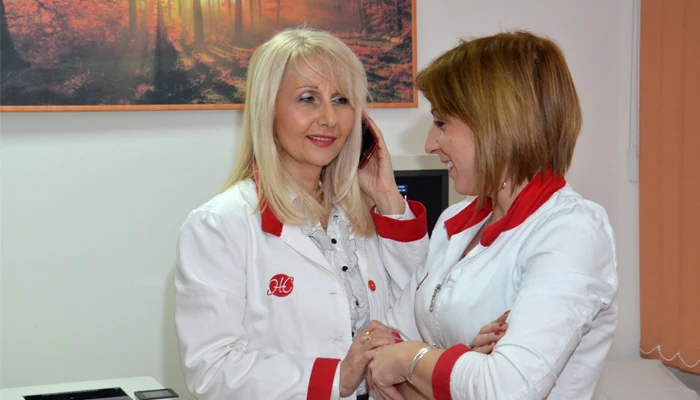
In the specialist office of rheumatologist Dr Sandra Živanović, a new, completely biological method is beginning to be applied: a drug for degenerative joint diseases is made from the patient's own blood! This is a procedure applied abroad, and for now in Serbia there are few licensed doctors for this method. It is used by drawing blood from the patient, and from that blood, Dr Živanović, through a special procedure, prepares a drug which is then injected into the affected joint – knee, elbow, hip.
This means relief for thousands of people in Šumadija, older and younger alike, who wake up every day with joint pain and may need as much as an hour to get moving in the morning. It also offers relief to those whose degenerative joint changes make walking difficult and getting into a car or boarding a bus a struggle.
Rheumatologist dr Sandra Živanović opened a specialist practice at the beginning of September on Bulevar kraljice Marije 19. The practice is equipped with modern equipment that allows specialists to gain insight into events in deep joint and tendon structures.
Dr Živanović deals with the diagnosis, monitoring and treatment of rheumatic diseases. These include degenerative, inflammatory, systemic diseases, and metabolic diseases such as gout and osteoporosis. These are diseases that involve pain in joints, muscles, tendons, ligaments, with joint swelling and limited mobility.
- Alongside the clinical examination, our practice also performs ultrasound examinations, which are a great aid in identifying health problems and an extension of the doctor’s reach. I perform ultrasound examinations of soft tissues, including joints, tendons, ligaments and all soft tissues around the joints. With ultrasound, for example, I can clearly see which tendon is damaged in the shoulder joint and then, under ultrasound guidance, administer an injection directly into the damaged structure. I also use ultrasound to examine deep structures such as the hip, and can administer injections into the hip joint in cases of swelling or other changes in the hip. These interventions can help the patient immediately, explains dr Sandra Živanović, one of those doctors who can clearly explain every detail of an illness to patients without using cumbersome terminology.
This rheumatology practice will also offer the aforementioned entirely biological method. A treatment made from the patient’s own blood will be used.
- This blood requires a special preparation method. The patient’s blood is drawn in the morning, which can be done in our practice. After the blood is processed, involving only centrifugation and incubation in certain types of test tube, the blood, or rather the plasma, is stimulated to produce growth and regeneration factors, as well as some anti-inflammatory factors. After the blood has spent a certain number of hours in the incubator, we obtain five doses of the medicine. I administer them to the patient over one week. I return the patient’s own fluid, enriched with regenerative factors – growth factors and anti-inflammatory factors. This natural medicine is injected into the affected part of the body, into the affected joint. It is something very new and entirely biological, explains the rheumatology specialist.
She says that our society commonly regards joint pain as a natural part of ageing. Dr Sandra Živanović explains that old age should not hurt and that she knows how to achieve this goal. The importance of appropriate joint treatment is clear when one considers that some degenerative bone diseases lead to complete disability if they are not treated in time. Degenerative disease means that the cartilage in the joints is deteriorating.
In addition to this, the most modern medicine, Dr Živanović also uses more well-known medicines in treatment, such as long-acting corticosteroids, but with special caution due to the side effects of the medicine.
Viscosupplementation is also performed at the specialist practice of Dr Sandra Živanović. A gel preparation is injected into the knee, hip joint or another damaged joint. It helps improve knee movement and slows the degenerative process.
All these medications are injected into the joint via injection. The needle is 'guided' by ultrasound precisely to the place where the medication needs to be introduced. Each joint has its own 'needle', says dr Živanović, so for hand joints, the thinnest needles, insulin needles, are used. The aim is for the intervention to cause minimal pain to the patient, says dr Živanović, adding that the rheumatologist's task is to treat and not allow the disease to cause pain, neither to the old nor the young.
Source: www.kragujevacke.rs